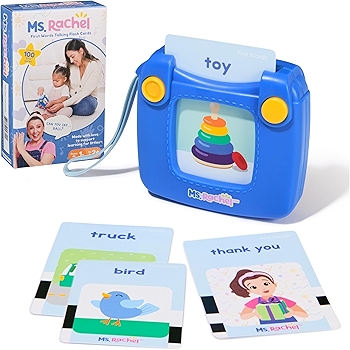

This language learning set is tailored for households and educational settings that prioritize dual language exposure for young children. It supports early vocabulary acquisition in both English and French, helping learners connect words with corresponding images through a hands-on, screen-free approach. The design aligns with Montessori-inspired learning principles, encouraging self-directed exploration and cognitive development in a relaxed, engaging format.
Ideal use scenarios include daily language routines at home, language support in preschools or therapy playrooms, and travel activities that keep little learners engaged. While it serves as a valuable supplementary tool for building vocabulary and pronunciation, it is not a substitute for professional language therapy when clinically needed, and may be less suitable for children who require highly structured phonics instruction or screen-based interaction.
Two language pairing with visual cues: Each card presents an English word alongside a French equivalent with a clear image, reinforcing word recognition through simultaneous auditory and visual cues. This integrated approach accelerates memory formation and encourages quick association between label and concept.
Diverse content for broad vocabulary: The card set covers common categories such as fruits, shapes, colors, animals, and transportation. The wide variety supports incremental vocabulary growth, cross-category thinking, and the ability to form simple phrases in both languages in real-world contexts.
Montessori-inspired independent play: The physical card system is designed for easy insertion and removal, promoting hands-on, self-guided learning. Children learn to focus, follow a sequence, and take ownership of their learning moments without reliance on screens or adult prompts.
Audio-enabled language practice: Pronunciations accompany card playback, allowing learners to imitate sounds and develop listening comprehension. The straightforward format helps young users practice speaking with real-time feedback in a low-pressure setting.
Durable, child-friendly construction: The cards and housing are built to withstand daily handling, with rounded edges and robust materials. A compact, reusable box keeps components organized for easy storage and transportation.
Non-screen, low-distraction learning: The absence of digital screens helps maintain attention on real-world objects and language targets, supporting focused language development and fine motor skills through tactile interaction.
The set uses durable plastic components designed to endure frequent insertions and removals. Materials are chosen for safety, with smooth finishes and rounded corners to minimize wear and tear and reduce risk during active play. The assembly emphasizes reliability, ensuring long-term performance even with daily use by young children.
Storage and packaging are conceived for practical daily life—compact dimensions, a protective box, and neatly organized cards help maintain order between sessions. The overall craftsmanship aims for stable operation, with components fitting together securely to prevent misalignment or damage during use.
Users typically insert a card into the module to trigger spoken prompts, then repeat the word aloud while visually confirming the corresponding image. This process blends tactile exploration with auditory and visual learning, supporting memory retention and pronunciation practice in a natural, unhurried tempo.
Daily use tends to be intuitive: little hands can pick a card, insert it correctly, hear the word, and then explore related pictures. For best results, sessions should be short and focused, gradually increasing the range of vocabulary as confidence grows. Regular handling also reinforces motor coordination through controlled card insertion.
When evaluating bilingual learning tools, consider how well the product pairs languages with engaging visuals, the breadth of content, and the ease of independent use. Compared with screen-based apps, this option emphasizes hands-on interaction and real-world item recognition, which can reinforce durable learning habits. Price, durability, and language coverage are important factors to weigh against personal learning goals.
Important considerations to guide the purchase include how to choose between purely digital resources and card-based tools, which type is better for early language development in bilingual households, and what to look for in terms of card variety and audio clarity. Common mistakes to avoid include opting for low-contrast imagery, limiting language exposure to a single category, and selecting tools without independent-use design for young children.
To extend the life of the set, wipe components with a gentle, dry or lightly damp cloth and store them in the provided box when not in use. Avoid submerging the electronics or subjecting the cards to excessive moisture, which can affect sound quality and card integrity. Regular inspections help catch loose connectors or bent cards before they impact performance.
Tip options include establishing a routine that alternates categories across sessions, ensuring clear pronunciation practice, and gradually introducing new vocabulary as familiarity grows. Keeping the pile organized by category speeds up setup and encourages children to take pride in neat, orderly learning spaces.
This tool is well suited for gifting to families with multilingual homes, early education settings, and therapy-support environments where language development is a priority. It pairs nicely with other Montessori-inspired activities and can complement traditional reading routines, providing a tactile bridge between picture recognition and spoken language.
From a value perspective, the system offers a reusable, non-screen learning resource that promotes independent exploration and bilingual exposure. Its compact form and durable construction make it a practical addition to a language-rich learning toolkit, suitable for daily use at home or in classroom corners.
Keywords: #bilinguallearningtoys, #englishfrenchlanguagecards, #earlylanguagedevelopment