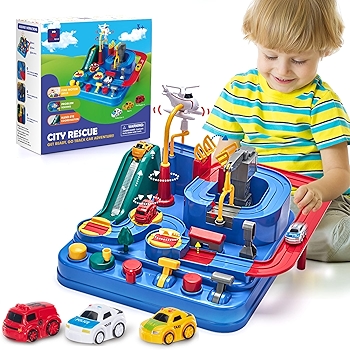

The modular track system is designed for children and families who enjoy building, racing, and customizing layouts. It suits fans of Hot Wheels who want to experiment with track shapes, stunts, and launches, in both solo and group play settings. Its adaptable design supports evolving play styles—from quick races to complex multi-lane sequences—and is well-suited for use at home, in playrooms, or during classroom demonstrations of basic physics concepts.
Ideal use scenarios include creating multiple runways with varied configurations, integrating with existing playsets, and storing compact layouts when not in use. While it excels in flexible setups and portable play sessions, it may be less suitable for very small desks or spaces where frequent reassembly is required due to space constraints.
Modular snap track system enables quick assembly and reliable joints with a simple snap interface. This design supports rapid layout changes without tools, allowing the play space to adapt to different stories and challenges. Real-world benefit: faster setup times and more time for racing action.
The interlocking joints provide stable connections that resist gaps and derailments during high speed passes, even on moderate floor textures. This reliability matters for uninterrupted play sessions and consistent car performance across layouts.
Diverse track lengths and connectors offer extensive layout options by combining short and long sections with secure transitions. This flexibility helps accommodate different rooms, furniture layouts, and learning goals such as speed control and momentum design. It also scales with the playgroup as interests grow.
Connector pieces maintain smooth transitions between sections, reducing friction points that can slow cars or cause skids. Practically, this translates into more predictable runs and easier troubleshooting when a layout is adjusted mid-play.
Included vehicles and launcher compatibility provide immediate play value with ready-to-run cars and compatible launch mechanisms. This enables action right out of the box and supports fast competitions among siblings or friends. The launcher interaction introduces an element of skill and timing to racing sessions.
Durable construction using kid-friendly plastics and reinforced joints supports repeated assemblies and disassemblies. This durability helps maintain performance over time and encourages imaginative play through many configuration cycles.
The track parts are designed to tolerate regular handling and the occasional drop, with smooth surfaces to minimize tire wear and scratch risk on painted finishes. The plastic components are laser-checked for consistent tolerances to ensure easy snapping and secure seating between pieces.
Attention to joint design and ramp geometry reduces warping and creates uniform driving experiences across different sections. The materials balance lightweight handling with long-term resilience, supporting daily use by children and family members of varying ages.
Daily usage emphasizes intuitive setup, clear slotting of pieces, and stable runs that hold together during fast laps. The lightweight segments are easy for younger hands to manage, promoting independent play and creative experimentation with layouts.
Stability is enhanced on solid tables or dedicated play mats; on soft or uneven surfaces, ensuring all connectors are fully engaged becomes more important to prevent shifting during intense runs. Clean surfaces and regular checks of end connectors help sustain reliable operation.
Compared with fixed, non modular tracks, a modular kit prioritizes adaptability, compact storage, and future expansion. It tends to suit households that want to reconfigure layouts for new stories or optimize space during different times of the day. For classrooms or after school environments, the modular approach supports collaborative play and quick demonstrations.
How to choose a modular track kit hinges on space, expected layouts, and compatibility with existing cars and launchers. Which type is better depends on whether the priority is maximum stability or maximum flexibility. What to look for includes connector reliability, track curvature options, and the availability of expansion sets. Common mistakes include selecting a kit with limited extension options or assuming universal compatibility without verifying end connections and launcher compatibility.
Maintenance involves regular inspection of joints and ramps for signs of wear, and routine cleaning to remove dust that could affect track friction. Wipe surfaces with a soft cloth and avoid harsh cleaners that might degrade plastic finishes.
Storage and safe handling are key to longevity; store pieces in labeled containers or bags to prevent misplacement, and keep small parts out of reach of younger children when not in use. Safety notes include supervising assembly to avoid pinched fingers and keeping play areas clear of clutter during setup and disassembly.
The kit works well as a thoughtful gift for birthdays, holidays, or family celebrations, especially for children who enjoy building and racing. It also suits shared play spaces such as living rooms, playrooms, and daycare centers where collaborative layout design and friendly competition can thrive.
From a value perspective, the ability to reconfigure and expand provides ongoing play value without frequent repurchases. When paired with an existing Hot Wheels collection, this modular system extends storytelling possibilities and encourages longer, more interactive play sessions.
Keywords: #HotWheelsTrackSet, #ModularTrackSystem, #DieCastCarPlay